
Need Help? Click Here To Contact Us
THE INVISIBLE EXPERTISE PATTERN IS BELOW
Why Your Clients Can Describe What Makes You Different Better Than You Can
You can do the work. But the moment someone asks you to explain it, the words just stop. And the deeper your work goes, the harder it gets to describe.
If you’re here, you’ve probably spent years being very good at something you still can’t quite explain. That’s a strange, specific frustration, and it’s the one this page is about.
What Your Market Recognises And Values
Think of the last time work you should have won went to someone else.
Someone you knew, with certainty, you had more depth than.
It still went to them.
You went home and told yourself you were just bad at the selling part.
That you should be better at this by now.
You’re not bad at it, and this was never the thing you thought it was.
Here’s what actually happened in that moment, because it isn’t what it felt like.
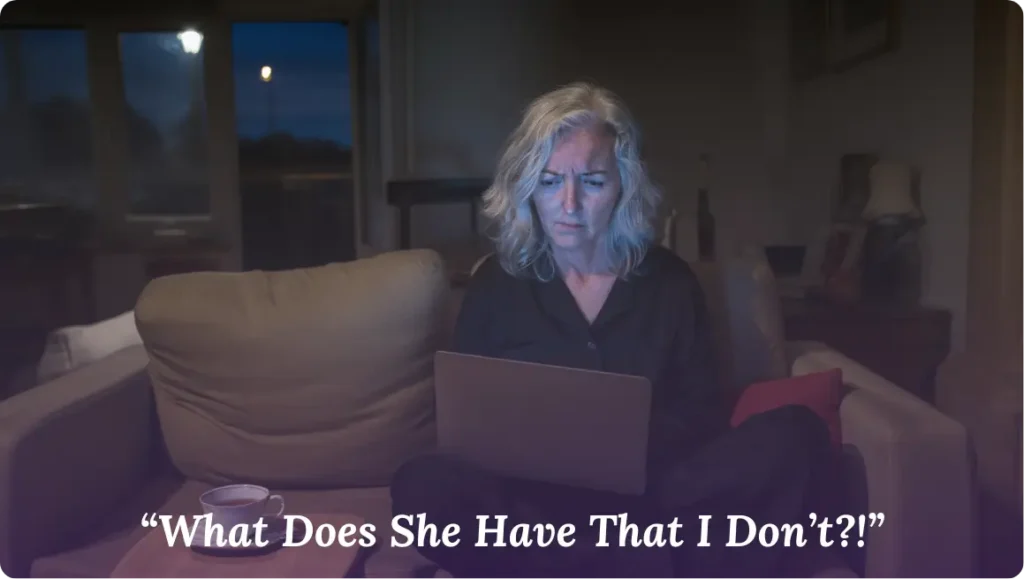
It felt like a loss on merit, like maybe they had something you didn’t.
They didn’t.
What they had was one thing: they were legible.
They could say, in a clean sentence, what made them different, and you couldn’t.
Because when a buyer is choosing, they cannot see depth.
They can’t reach into two practitioners and feel which one is more skilled.
Depth is invisible from the outside.
So they choose on the only thing they can see: the one with a clear, nameable difference over the one whose difference is real but unsaid.
Sit with that, because it flips the thing you’ve probably been telling yourself.

You haven’t been losing because you’re not good enough.
You’ve been losing because you’re better in a way the market can’t see.
Your depth is real.
It’s just invisible from the outside, and invisible loses to legible every time.
Not because legible is better, but because legible is the only thing anyone can actually look at.
That’s the whole mechanism.
The market doesn’t reward the best practitioner.
It can’t find the best practitioner.
It rewards the one whose difference it can see.
Being better was never the problem.
Being unseeably better is.

Which means the thing standing between you and the work that keeps going elsewhere isn’t more skill.
You have the skill.
It’s that your difference, the real one, the one your clients feel and your peers sense, has never been pulled into words the market can see and choose.
Name it, and for the first time you’re not competing on depth the buyer can’t assess.
You’re competing on a difference they can finally see, which is the only competition that was ever actually happening.
Which raises the obvious question.
If naming your difference is the whole fix, why haven’t you just done it yourself?
You’ve tried.
Of course you have.
New bio, another run at the sentence, a dozen drafts.
And it never quite held.
That isn’t for lack of effort or intelligence, and it isn’t because it’s hard.
It’s that there’s one specific position your difference can’t be named from, and it’s the one you’re standing in.
I can see this so clearly in other people for one reason: I spent years unable to see it in myself.
“I finally have language for it.”
Anna, Creatives Energy Cycle Practitioner [▶ 1 minute clip]
Where This Started For Me
I got a degree in structural engineering, and practiced it for years.
Eventually, I started a business designing homes, both the engineering and architecture.
Early on I was good at it, the kind of good where a family walks through a finished house and feels something they can’t name.
And in the same breath, I couldn’t explain why.
That gap capped everything.
From the outside I looked like every other person who designs homes.
And as a result the bigger work kept going to people who weren’t as good but could say what they did.

Then, I was at a house party one night.
A stranger asks what I do.
I tell him: I design houses.
He looks at me, flat: “that’s not real design.”
I had no answer.
Not because he was right.
But because I had nothing to show him he was wrong.
I went home and asked a different question.
Not how do I market this better, but: what do I actually do, in order, every time, that makes a design work?
I wrote it down.
A real process, running underneath me for years, never once said out loud.
The moment I could describe it, the ceiling lifted.
Not because the work got better.
It didn’t.
It was because the work became something the world could see and build on.
That business ran nine years.
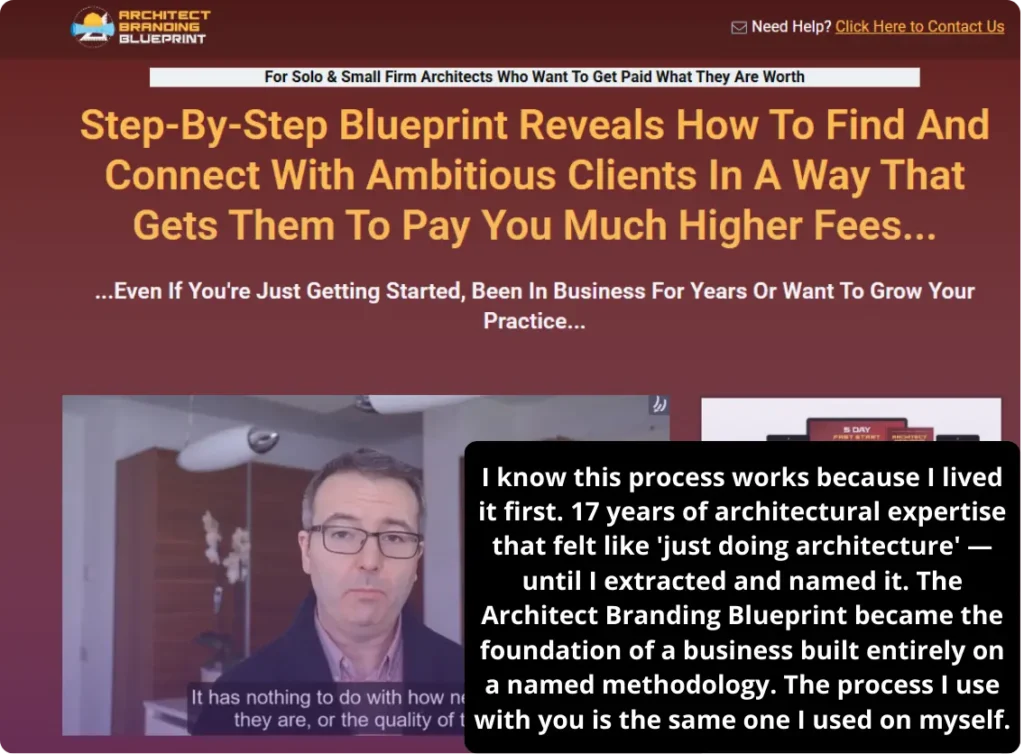
Then I did the same for architects.
Not a handful.
Six years, and a hundred and forty of them, one after another.
Each one certain their process couldn’t be pinned down, each one wrong in exactly the same way.
Then I moved to practitioners, and the pattern held completely.
Coaches, therapists, healers, mediators, well over two hundred of them now, across a dozen fields that have almost nothing else in common.
That’s the thing I’ve done, methodically, session after session, for over a decade.
Long enough that I can now usually name the shape of someone’s work inside twenty minutes.
This is because the pattern that hides from the person carrying it, can’t hide from someone standing outside it if they know what to look for.
You might reasonably wonder why, after finding something this consistent, I don’t just keep it and build one enormous practice around it myself instead of spending an hour a time doing this for other people.
Here’s the honest answer: I only found the pattern in the first place by doing it repeatedly, for other people, across completely different fields.
One practice, run by one person, would have shown me nothing beyond that one person’s story.
It only stays sharp, and it only keeps working across fields as different as grief counselling and leadership coaching, because I keep doing it for someone new.
Keeping it to myself wouldn’t have protected it.
It would have starved it.
But why is this so hard for practitioners to do for themselves?
“I finally have words for what I’d been doing all along.”
Tarnia, Occupational Therapist & Strategic Intervention Coach [▶ 1 minute clip]
The Expertise Paradox™
You’ve probably already tried to fix this, more than once.
But there are two reasons your own method hides from you.
Neither one is a flaw.
The first: your process is just something you do.
You call it intuition, a feeling you get.
And you’re right, it is.
A client says, “that thing you did last session, where you asked one question and everything shifted, how did you know to do that?”
And your honest answer is, “I don’t know. I just felt it.”
But that’s not all it is.

I’ve sat with over 200 practitioners, and even when the work looks completely intuitive on the surface, I have always found the methodology underneath, driving all of it.
The more expert you become, the more invisible your method gets, because it’s become second nature.
This is The Expert Paradox™, and it’s like asking a fish to describe water.
You’ve been swimming in your methodology for years.
It’s so woven into what you do that the words for it never quite come.
You walk into a session, read the room, make a dozen decisions in the first ten minutes.
Ask you afterward to describe what you did, and you’d hesitate.
Not because you don’t know.
But because you’ve stopped noticing.
The second reason sits underneath the first: you do this for everyone but yourself.
You sit across from a client and see the structure in their story that they’re too close to see.
Seeing the pattern someone can’t see from inside it, that’s the entire job.
But you can’t do it for yourself, for the same reason a surgeon can’t operate on her own heart.
It isn’t a question of skill.
It’s a question of position.
The lens you’d use to examine your methodology is the methodology.
It’s why AI can’t do this for you either.
Ask ChatGPT and it will organise your words beautifully and hand you back what you already know, only tidier, because it can only work with what you feed it.
And what you’d feed it is your description of your work, which is the exact thing that’s missing.
It can’t see the difference you can’t see yourself.

So if part of you has quietly believed you should have sorted this out alone, years ago, you couldn’t have.
No one sees their own pattern from the inside.
That isn’t a personal failing.
And it’s the one part of this work that genuinely needs another set of eyes.
Which means every fix you reached for, better words, more confidence, another credential, was aimed at a problem you never actually had.
And then there’s the cruellest explanation of all, because it sounds like humility:
“I was certain I didn’t have a method. Then I saw it.”
Rosemary, Spiritual & Intuitive Healer, 20 years in practice [▶ 30 second clip]
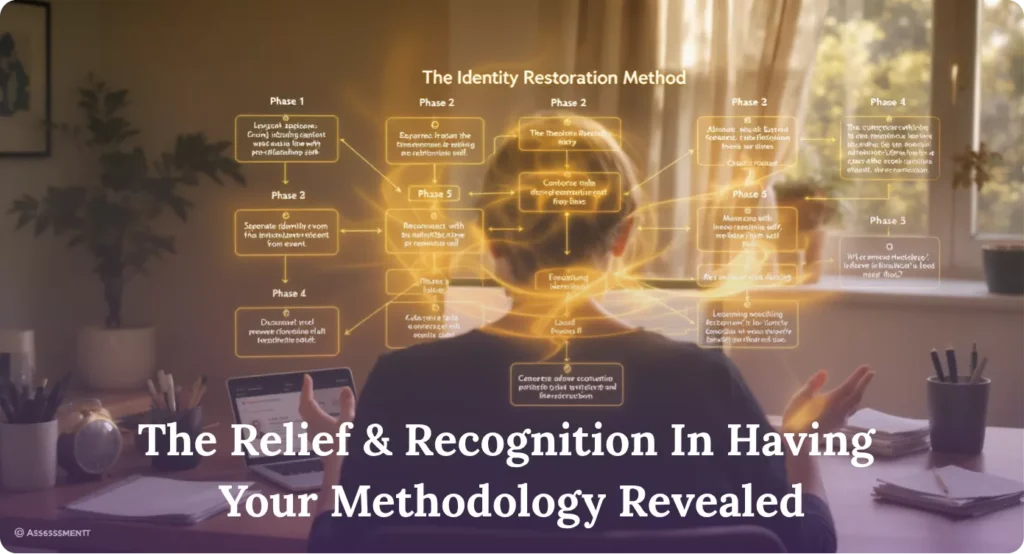
It's Not A Mindset Problem, It's That Your Difference Has No Name Yet
There’s one explanation you may have reached for more than any other:
That the reason you stay invisible is YOU.
Your mindset, your confidence, some inner block you haven’t cleared yet.
That if you just believed in yourself a little more, the words would come and the right people would find you.
You may have been told this directly.
Most practitioners in this position have.

Patricia had carried it that way for years.
Every few months she’d open the “About” page on her website to finally fix it, write a paragraph, read it back, and delete it.
She’d decided she was too private for this, too reluctant to put herself forward, that someone with real authority would have found the words years ago.
Not one of these failings were hers.
After five, ten, twenty, thirty years of doing the work, the problem was never your worth, your confidence, or your mindset.
You’re not a mindset away from being seen.
You’re one name away from being told apart.
The method you run on instinct simply has no language yet, so the market has nothing to recognise you by.
It’s a missing structure: a name and a description the market can understand and value.
You’ve been trying to heal something that was never broken.
So here’s what becomes possible once it’s named.
“Seeing it broken down like that blew me away.”
Ursula, Counselor [▶ 1 minute clip]
What Changes The Day Your Work Has A Name
Someone asks what you do, you don’t reach, and you don’t watch their eyes glaze over from a generic answer.
One clean line comes out, and they lean in to find out how it works, because for once the answer is as specific as the work behind it.
The question you used to brace for becomes the one that opens the door.
A colleague describes you to someone they’ve just met, and instead of “she’s wonderful, you should really talk to her,” they say the name of what you do, in one sentence, precisely.
That person books before they’ve even met you, because they already know they’ve found the one who does exactly this.

You say your increased fee, and your voice stays level.
No fumbling, no over-explaining, no quiet flinch while you wait for the reaction.
Because there’s a named thing on the table now, a real and specific method, and they can see what they’re paying for.
The number stops being weighed against every other practitioner in the field, because there’s no longer a like-for-like to weigh it against.
A stranger finds your website at eleven at night.
In one look, they can tell there’s a real, distinct practice here, not a vague approach that could be anyone’s.
The right ones book.
The wrong ones move on before they ever reach you, so the calls that land are already the ones you want.

And the work itself, the thing you’ve quietly been excellent at for years, stops being something only you can do and becomes something with your name on it.
A method others refer to.
A body of work you can build a book around, a program around, a reputation around.
The same practice you already run, at the scale it should have had all along, because the market can finally see what makes you different from everyone else doing something that sounds the same.
And if more visibility is the part that gives you pause, notice what actually gets seen and evaluated: the method, not you.
A named method is the thing that goes out and gets chosen, so the work can travel without asking you to perform or stand in the spotlight to explain it.
So how do you name your method?
How We Do This
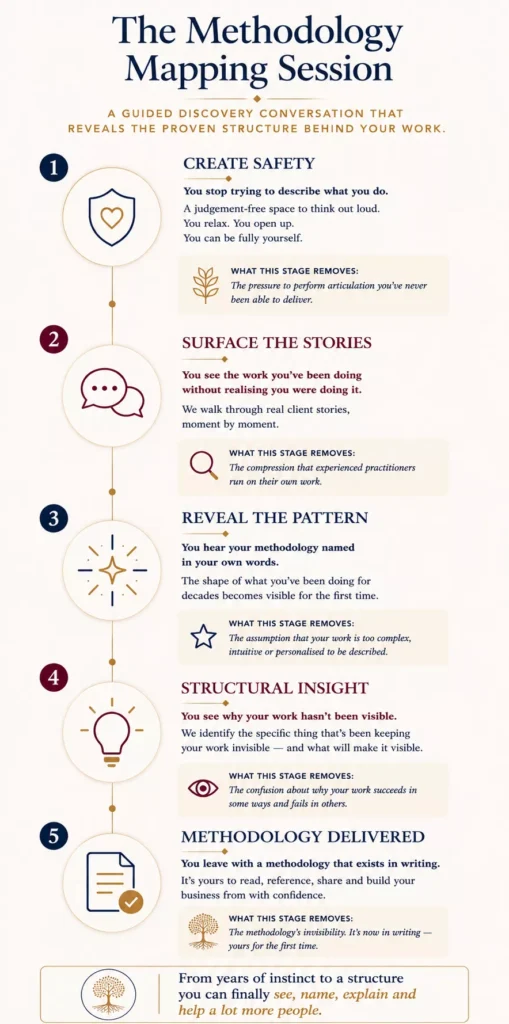
It’s called a Methodology Mapping Session.
It takes roughly one hour, sometimes less, sometimes more depending on how close you are to your process, it takes as long as it takes.
It’s one conversation, and its only job is to find and name the method you can’t see from the inside.
You sit somewhere quiet, and talk about a few recent clients: what they walked in carrying, what you did, what changed.
Not performing.
Just talking.

Somewhere in our conversation, I’ll say: “you just described the same thing three times. Did you notice that?”
You didn’t.
Almost nobody does.
And there’s a reason it takes a second person: I’m not listening for what you say.
I’m listening for what you do the same way every time and never notice.
The move you always make.
The order you always follow.
The question you always ask third.
Those repetitions are the method, and you can’t hear them because they’re automatic, and I can because they’re the only thing I’m listening for.
Over two hundred practitioners have sat in that chair certain they had no methodology.
Every one of them did.
There’s a French cook who made something excellent for years and called it only “the chicken thing.”
Then one day it became Coq au Vin.
Nothing about the dish changed.
But now it could be ordered.
Remembered.
Built into a menu, a reputation, a name.
The dish was always that good.
It just became something you could build on.
That’s what’s waiting for your work.
“How did you do that? That’s the thing I could never put into words.”
Rosalind, Spiritual 12-Step Guide, New Zealand [▶ 2 minute clip: the moment she hears it said back to her]
What You Walk Away With
By the end of the session, you’ll have watched your methodology emerge in real time.
Within the next 48 hours, everything we’ve uncovered is organised and sent back to you.
You don’t leave with vague insights or pages of handwritten notes.
Here’s what you’ll be holding — and what each piece lets you finally do.
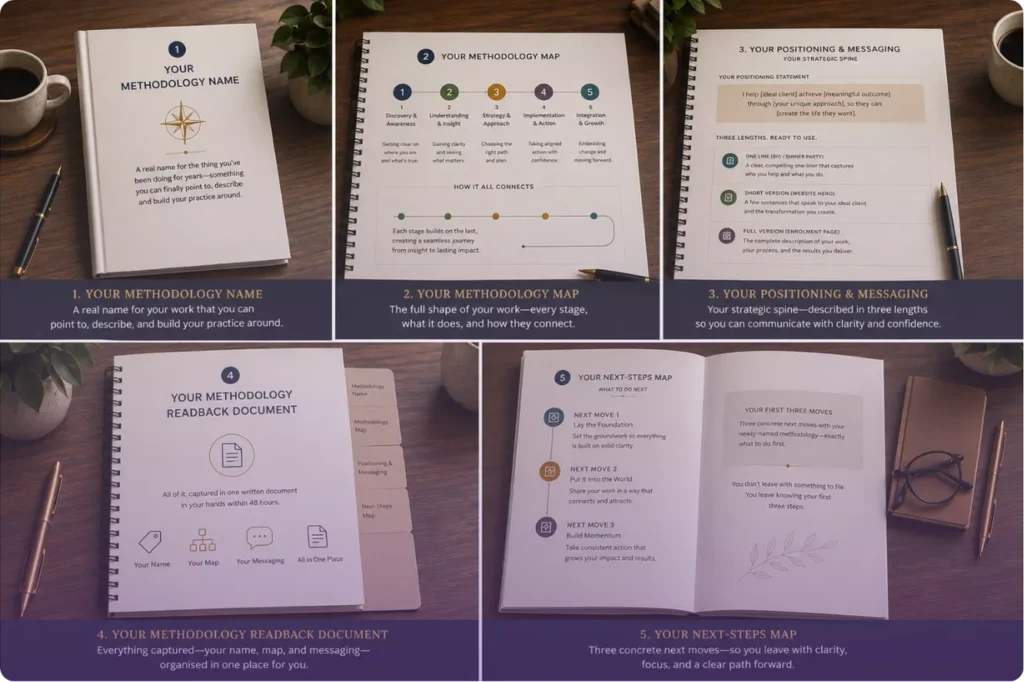
1. Your Methodology Name:
You’ll finally be able to say what you do in one phrase and watch as potential clients want to find out more.
So the next time someone asks what you do…
…instead of the long, winding explanation that loses them halfway, you say one phrase — the name of your method — and watch them lean in and ask, “what’s that?”
That’s the moment the name gives you: the question stops being something you dread and becomes the door you walk people through.
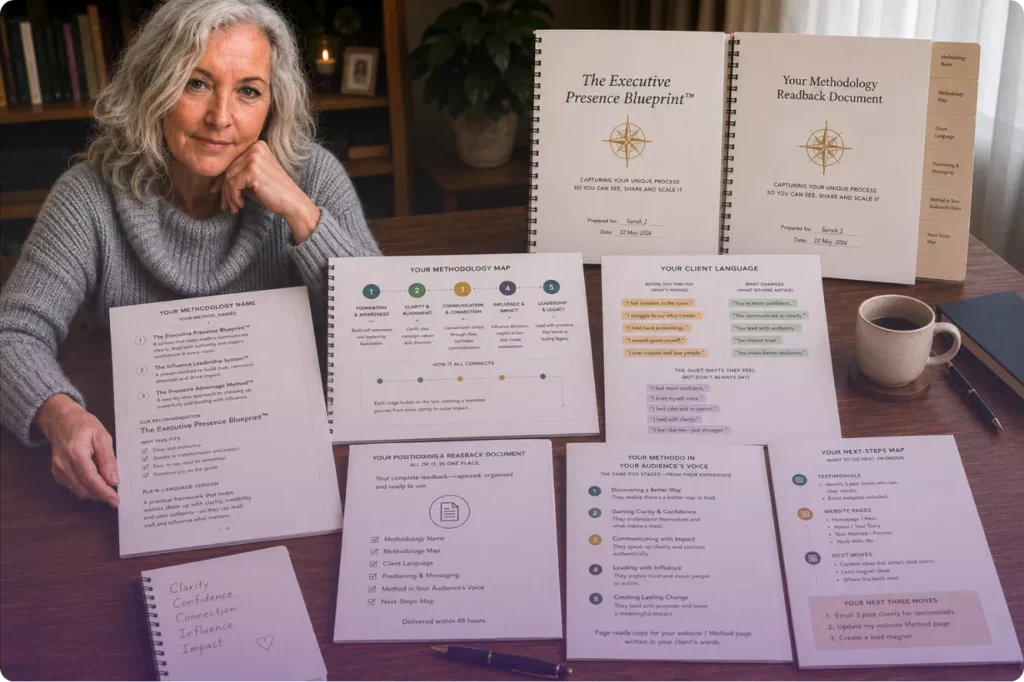
2. Your Methodology Map:
For the first time, you’ll see the whole shape of your work on a single page and know it was real all along.
This is the one you’ll read and feel something settle.
For years you’ve sensed there was a structure under what you do, but you couldn’t stand far enough back to see it.
Here it is on the page, the thing you run on instinct, finally visible to you.
Once you see it you’ll think:
“That’s it. That’s what I’ve been doing all along, and it’s real.”
3. Your Positioning & Messaging:
You’ll answer “what do you do?” without searching for words ever again.
It’s the strategic spine of how you describe your work plus that description written out, ready to use.
First, a single positioning statement: the one true sentence about who your work is for and what it does, so you never have to invent your message from scratch again and everything you write checks against it.
Then it’s written out for you in the three lengths you actually need: one line for your bio and the dinner-party answer, a few sentences for your website hero, and a full version for your enrolment page.

4. Your Methodology Readback Document:
All of it, captured in one written document, in your hands within 48 hours.
So none of what surfaced in the conversation evaporates the moment the call ends.
You’ll have the whole thing — your name, your map, your language, your messaging — in a single document you can return to whenever you sit down to write, refine, or explain your work.
You don’t have to remember it or rebuild it.
It’s written down, it’s yours, and it’s there for good.
And one more thing— included, but not on the headline, because it lands better as a surprise.
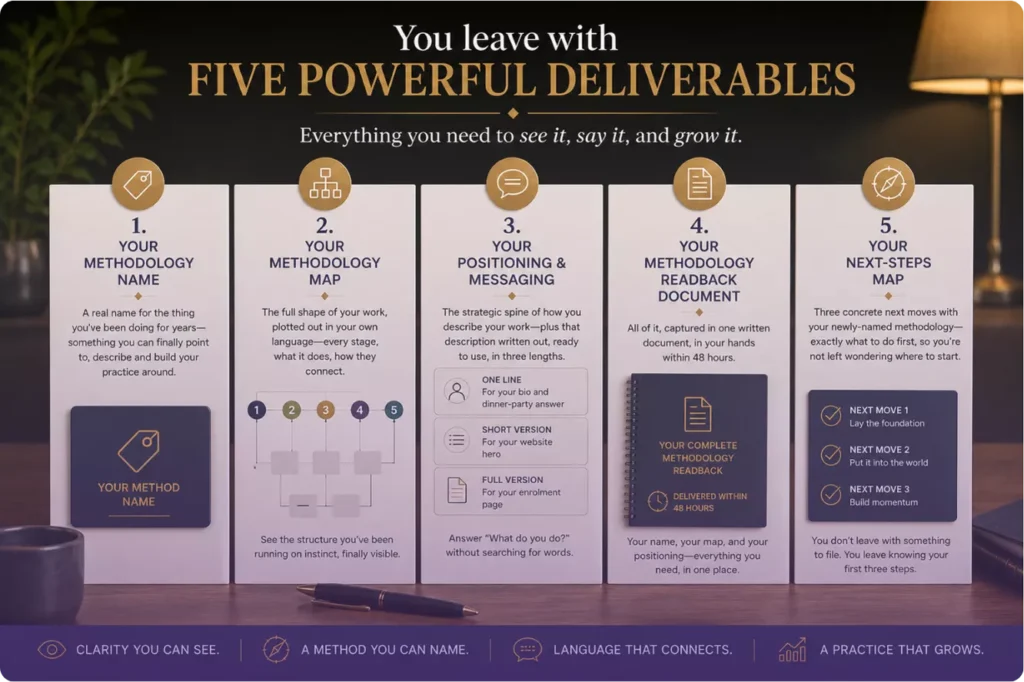
5. Your Next-Steps Map:
The readback doesn’t stop at “here’s your method.”
It gives you three concrete next moves with your newly-named methodology, exactly what to do with it first, so you’re not left with a beautiful document and no idea where to start Monday morning.
You don’t leave with something to file.
You leave knowing your first three steps.
These assets are proof — in writing, in your hands — that what you’ve been doing for years was never improvised.
It had a structure.
Now you can see it, and so can everyone else.
The Methodology Mapping Session isn’t simply a conversation.
It’s the moment years of instinctive expertise stop feeling like luck and start being something you can see, name, and stand on with confidence.
The way practitioners tend to put it afterward is some version of the same two sentences: you gave words to the thing I could never name — and, more quietly, I realised I hadn’t been winging it after all.
From that point on, your methodology answers the question before you ever walk into the room.
“I came in expecting a chat. I left with the shape of my whole practice.”
Simone, Stress Mastery Consultant, Canada [▶ 90 second clip: the moment it became something else]
Her Own Version Of This
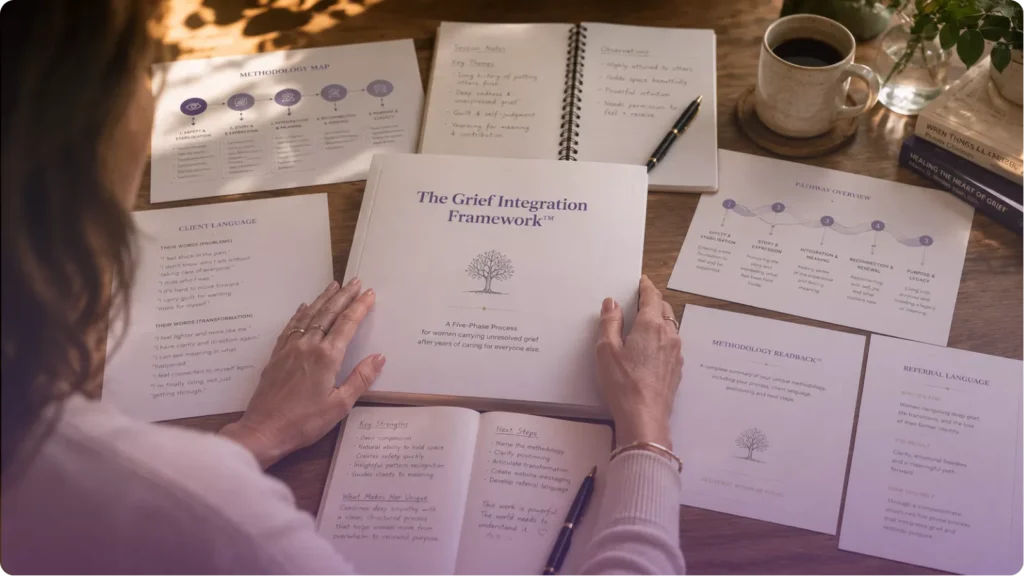
Patricia, a grief counsellor, 22 years in.
Already doing strong work, already booking steadily.
She heard her own four-phase process read back to her for the first time and finally had one sentence for what she’d been doing all along: the Grief Integration Framework.
Her next intake calls, “let me think about it” became “when can we start,” three times in four instead of once.
Her fee for the same ninety days moved from $800 to $3,000.
Not because she changed.
But because the market could finally see what made her different from every other grief counsellor.

And if it helps to know it, she wasn’t the exception she thought she was.
Every practitioner I sit with arrives certain her work is the one too intuitive, too personal, too uniquely hers to have a nameable shape.
Every one is wrong in exactly the same way, and every one privately thought she was the only one who couldn’t see her own.
It’s the most shared experience I know among the genuinely deep: the thing that feels most isolatingly yours, that you can’t name what you do, is the one thing nearly all of you have in common.
What’s different for each of you is only the method underneath.
That part is yours alone.

And if part of you worries that naming your method means claiming something that isn’t yours — that instinct is a good one, and it’s worth being precise about.
Naming your methodology doesn’t claim ownership of your field’s traditions — the techniques, the lineage, the things you were taught even by someone else.
Those stay exactly what they are, and you’d never want it otherwise.
What gets named is your synthesis: the particular way you combine, sequence, and transmit it — built over decades, that no single teacher handed you.
That through-line is genuinely yours.
And the most credible named methods honour their lineage openly.
Acknowledging where you trained doesn’t weaken your authority.
It deepens it.
“Forty-five years — and the first time it’s had a shape I can name.”
Resa, Family Mediator & Therapist [▶ 2 minute clip]
Whether This Is For You Yet
This isn’t for everyone, and it isn’t a matter of talent.
It’s a matter of timing.
If you’re early on, a year or two in, still assembling the pieces, the method isn’t formed yet.
There’s nothing to name because it’s still becoming.
Come back when it’s had time to run deep, and it will.

But if you’ve been at this long enough that your clients describe your work better than you can…
…If the thing you do has quietly become a body of work, coherent and distinctly yours, even though you’ve never once said it out loud…
…then you’re exactly who this is for.
Not the beginner reaching for a method.
The practitioner who already built one and never named it.
You already know which of those is true.
“I get five different answers when people ask what I do. Now there’s one.”
Carla, Facilitator, Published Author & Storyteller, 13 years in practice [▶ 3 minute clip: the moment five answers became one]
What This Asks Of You
An agency would charge thousands for this and even then, they hand you a framework or template and ask you to fill in your own method, which is the one thing that can’t be done from the inside.
I‘m not an agency, and this isn’t that.
Take a breath before this next part. There’s no rush on it, and there won’t be.
The investment for the Methodology Mapping Session (MMS) is $385 USD.
Three Hundred And Eighty Five US Dollars.
Click the link below to claim yours:
And to be clear about what you’re buying, because you can probably sense there’s more here: the Session is complete in itself.
There are ways to build on a named method later, if you ever want to, but none of them are required and none of them are what this is.
You walk away owning your method and everything you need to use it.
Whether you ever build anything further on that foundation is entirely your call, in your own time.
This isn’t the first rung of a staircase.
And if the method doesn’t surface, if you don’t walk away with your name, your map, and the lines to carry them, you pay nothing.
No forms, no conditions.
In over two hundred of these conversations, I’ve never once failed to find a method in a practitioner with real work behind her.
If there’s genuinely nothing there to name, there’s nothing to pay for.
I run these personally, so there’s a real limit on how many happen each month.
If it’s full, I’ll tell you the next date.
Press the link below to book your MMS:
“They call me the fairy godmother. I could never tell you how it works — now I can.”
Kerry, Leadership Coach, Institute of Managers and Leaders, Australia [▶ 3 minute clip: what’s actually behind the fairy godmother]
The Short Version
“Don’t even hesitate for a second.
Honestly, when I booked it I thought — he’s going to have his work cut out with me, it’s just so nebulous.
Afterwards, I feel quite liberated. I’m a bit speechless, one, that you managed to elucidate it, and two, that you got it all down. My God, I can’t thank you enough.”
— Jacque, yoga teacher trainer, UK
Someone will ask what you do again this week.
You’ll answer, and it’ll sound like everyone else, or you’ll have a line that’s yours and watch it land.
Underneath the losing is a quieter thing you don’t say out loud: the half-suspicion that maybe the difference isn’t real, that you’ve been getting away with it.
You haven’t.
It repeated too many times, across too many different people, to be luck.
There’s a real method under there.
You just haven’t been able to see it from the inside, because no one can.
Naming it is the first time you get to look straight at what you built, and know it was there all along.
And it won’t resolve on its own.
The work has been this good for years, and for years it’s stayed unseen, that’s the pattern, not an accident.
Another year of doing the work at this level and still being the one they can’t quite describe is the same year handed to whoever can be described.
Nothing about that changes until the work has a name.
Keep losing to legibility, or name the difference that was there the whole time.
Click the link below:
There’s nothing to prepare. Nothing to get right.
You just show up and talk about the people you’ve helped.
In your corner,
Declan Connolly
Founder, Courses Into Clients
Revealing and naming the methodology already present in your work — so the people who need you can find you.

P.S.: The Methodology Is Already There. It's Just Waiting To Be Seen.
Think about your last three clients.
The pattern that appeared across all three — the sequence you followed, the diagnostic moves you made.
If you can feel it but can’t name it, you’ve just put your finger on the exact gap this conversation resolves.
The session is where it gets named, press the link below and book yours:
This site is not a part of the Facebook website or Facebook Inc. Additionally, This site is NOT endorsed by Facebook in any way. FACEBOOK is a trademark of FACEBOOK, Inc.
Legal Disclosures
RESULTS DISCLAIMER:
The testimonials and case studies presented are from real clients who completed the methodology mapping process. However, individual results vary.
The FTC requires us to disclose that:
– Individual results will vary based on your practice area, years of experience, existing client base, level of implementation, and
other factors
– We make no guarantees regarding your income, client acquisition, or pricing outcomes
– The methodology mapping process produces a named methodology, written framework, and positioning language. Business results
downstream of those deliverables — including pricing changes, client acquisition, and revenue — depend on your implementation
and market factors beyond our control – The pricing changes and client results shown in testimonials reflect those specific practitioners’ experiences and may not reflect yours
– As with any professional investment, there is no guarantee of specific financial outcomes
TESTIMONIAL DISCLAIMER:
The testimonials shared on this page are real experiences from practitioners who completed the process. However:
– These results are not typical or guaranteed
– Your results may differ depending on many factors including your practice area, existing reputation, client base, implementation,
and market conditions
– We cannot and do not guarantee you will achieve any specific pricing, client acquisition, or revenue outcome
– Past client results do not guarantee future results
For details, contact: support@thepremiumpractice.com
SUPPORT:
For customer support, questions, or refund requests, contact:
support@thepremiumpractice.com
Average response time: 24-48 hours (usually much faster)
FACEBOOK DISCLAIMER:
This site is not a part of the Facebook™ website or Facebook™ Inc.
Additionally, this site is NOT endorsed by Facebook™ in any way.
FACEBOOK™ is a trademark of FACEBOOK™, Inc.
COPYRIGHT:
© 2026 Courses Into Clients. All rights reserved.
No part of this material may be reproduced or transmitted in any form without written permission.