
Need Help? Click Here To Contact Us
For Practitioners Whose Work Is Easier For Clients To Experience Than To Explain
How To Help The Right People Recognise What Makes Your Work Worth Choosing
So They Get In Touch
Show, don’t sell. The missing key to more of the right people getting in touch isn’t more posting, another directory listing, or paying someone else to describe you.
It’s showing them what actually happens when they start with you, so they can picture working with you and see why you’re the right person for them, before they ever get in touch.
Why Your Work Works is a guided process that helps you uncover what you already do when you start with a client and put it into words prospective clients understand, so contacting you feels like the natural next step.


What Makes Someone Get In Touch With One Practitioner, And Not The Other
Think about the last time you needed to explain your work to someone who’d never met you.
You might have described your training.
Your approach.
“I tailor it to each person.”
“It depends on the client.”
All true.
And prospective clients do need to know what you do.
That’s how they find you.
But the other practitioners they’re looking at do much the same thing.
Even when someone recommends you, the person they send looks you up first: your website, your social media profile, your directory listing.
What helps them choose is something most descriptions never show: what it would actually be like to start working with you.
Here’s why that matters.

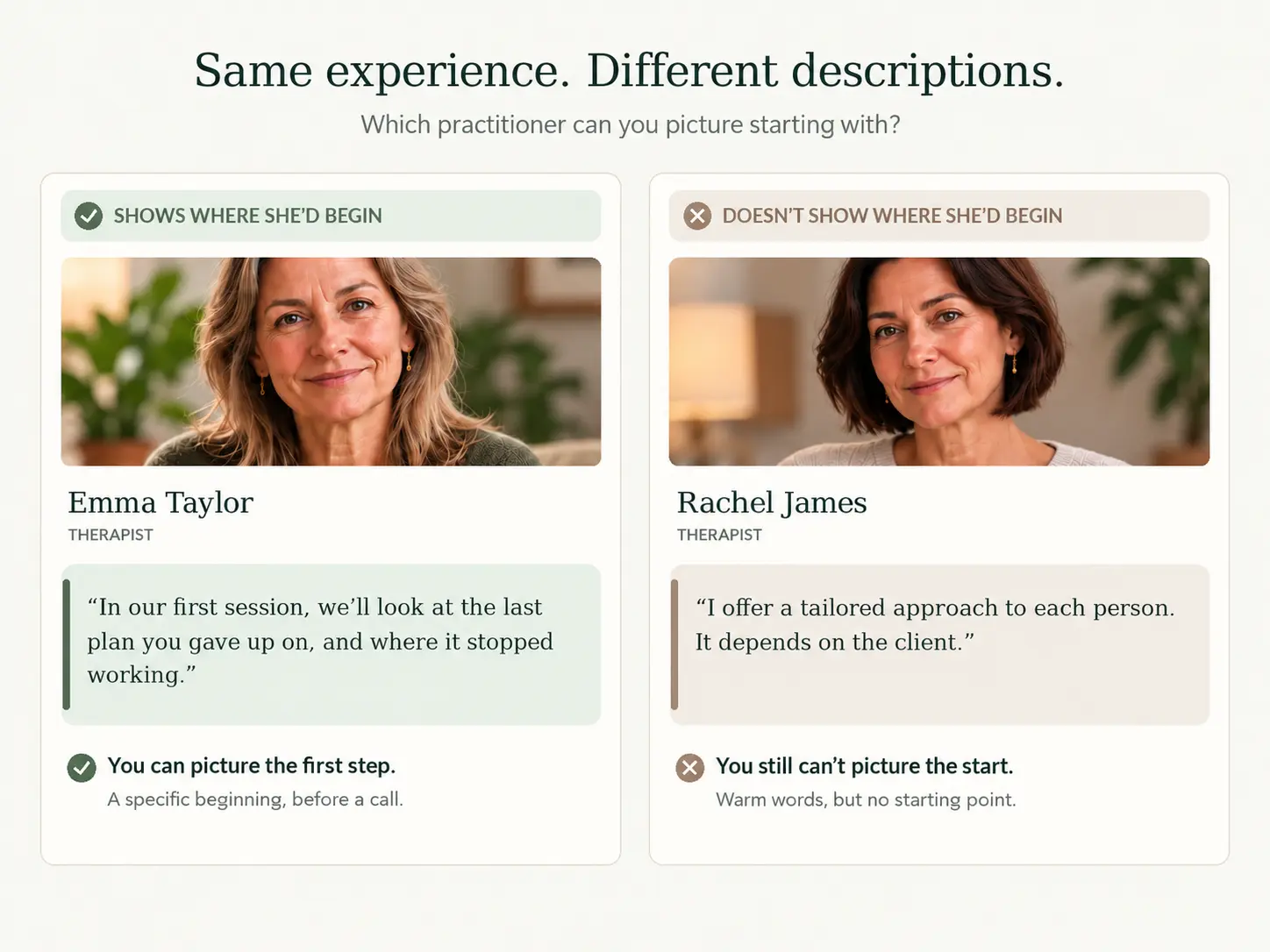
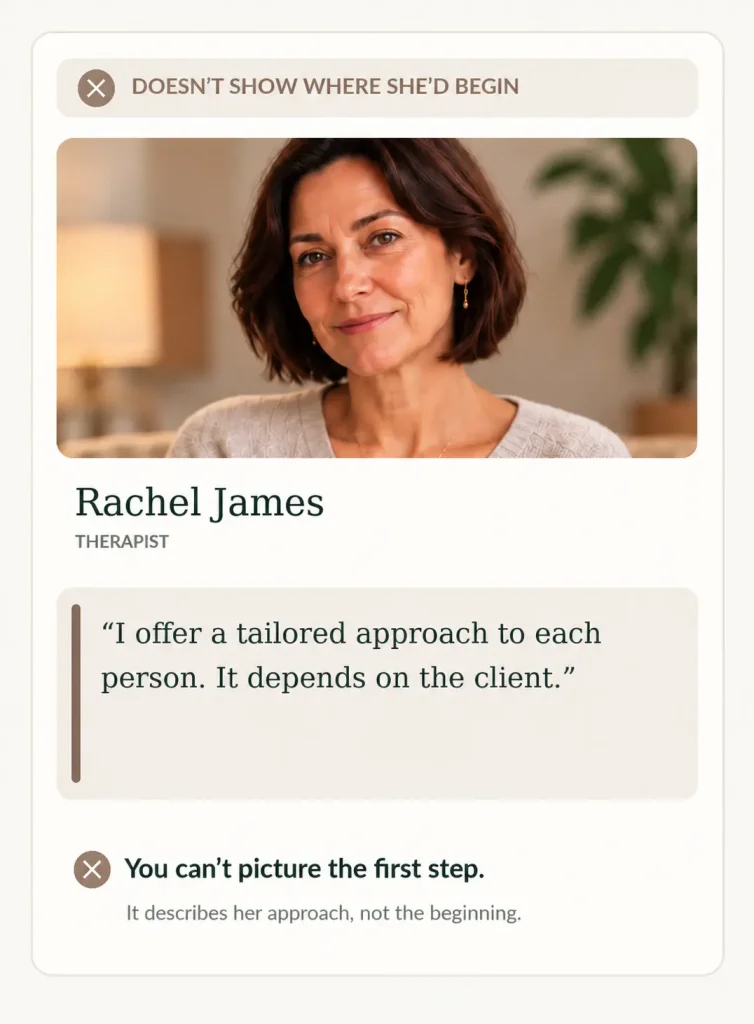
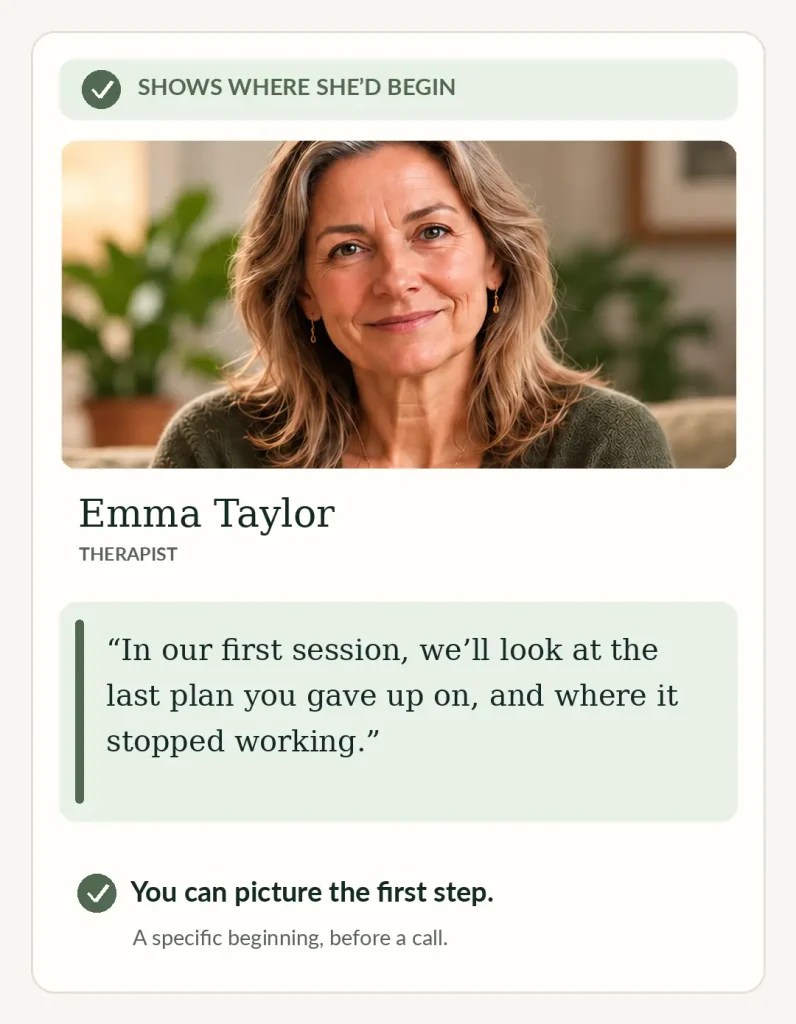
Imagine two equally experienced practitioners.
You visit the website of the first, and you can see where she’d start with you.
The second is just as good.
But her website doesn’t give you enough to picture how she’d begin.
So which one would you contact?
People feel safer with someone whose approach they can see.
A prospective client doesn’t need your whole method to decide whether to get in touch.
They need to trust that you’ll know where to start with them.
The beginning has the most unknowns, and it’s the first thing they’ll experience.
When they can’t picture it, some may still enquire but then go quiet.
Or question the fee before they’ve experienced what it pays for.
More visibility won’t fix that.
It just carries the same descriptions to more people.
But the missing detail isn’t another way of describing yourself.
It’s a way of describing the professional judgement you’ve been making with clients for years without thinking to explain it.
If you’ve had three clients you’d gladly work with again, you may already have it right now:
The 10-Second Test: Can You Spot How You Begin Work With A Client?
Think of a recent client where the work went well.
At the very start, before you did anything else:
What were you checking for, or making sure of?
If something came to mind, that may be part of your First Move: the judgement that guides where you begin with a client.
Was that just what this client needed?
Or is it something you find yourself checking for again and again?

One client gives you a clue.
Three give you something to compare, so you can see whether the same decisions keep showing up.
It’s exactly the kind of thing Why Your Work Works helps you look for across three real client cases.
And if nothing came straight away, that’s fine.
It’s easier to see across three real cases than from memory.
If the clues are in your client work, why are they so easy to overlook when you try to explain what you do?
How Years Of Experience Makes Your Expertise Harder To Explain
After enough years of client work, a practitioner starts noticing things, and responding to them, without stopping to think.
She notices when what someone says doesn’t quite match how they say it.
She holds back the thing that would be too much, too soon.
That professional judgement is her expertise.
But because those decisions come so naturally, she rarely thinks to explain them.
So when she describes her work, “intuitive” and “tailored” come out instead.
Yet those judgements are the very things that help a prospective client picture where they’d begin with her.

What I Noticed Across 241 Practitioners: They Have More Professional Judgement Than They Put Into Words
My name is Declan Connolly and I trained as a structural engineer.
The job was finding what carries the load underneath something complex.
When I started doing that with the work of experienced practitioners, I kept finding the same thing.
Across 241 of them, there was nearly always more judgement in the work than they were putting into words.
And the first sign of it was in how the work began.
Patricia was one of them.

Patricia Had 22 Years Of Experience But Had Never Described This Part Of Her Work
Patricia is a grief counsellor with 22 years of experience.
Her clients recommended her to friends… most never got in touch.
The friends looked her up, read the same words every counsellor uses, and most never got in touch.
When we first spoke, she said: “It depends on the client, really. I’m not sure I’d call it a method.”
So we went back into her client work and looked at what she did first.
Across very different clients, the same judgement shaped how she began.
In the first session, she looked for whether part of the grieving person felt that getting better would mean leaving the person they lost behind.

She’d never once put it into words.
So we did:
“In our first session, I won’t ask you to move on. I’ll listen for whether part of you feels that getting better would mean leaving the person you lost behind. If it does, that’s where we’ll begin.”
Imagine a woman who lost her father.
Part of her doesn’t want it to get easier, because easier feels like letting him go.
She’s never said that to anyone.
Then imagine she comes across Patricia, and those words name the exact thing she hasn’t been able to say.
That line went on Patricia’s website, social media profiles, and directory page.

Within a couple of months, her booked calls went from around 5 a month to around 9.
Her result is her own.
And her work hadn’t changed.
What changed was that the friends her clients sent could see how she’d begin working with them before deciding whether to get in touch.
Her years of experience were finally described as they actually are.
No performing. No exaggerating.
The words mattered.
But the judgement had to be recognised before it could be put into words.
Patricia found it in her client work.
That judgement was her First Move.
What might three of your own successful cases reveal about how you begin?

How To Find Your First Move By Looking Back At Three Client Cases
Why Your Work Works begins with the same step I took with Patricia: going back into successful client work to look at how it began.
Here’s how you do that with three cases of your own.
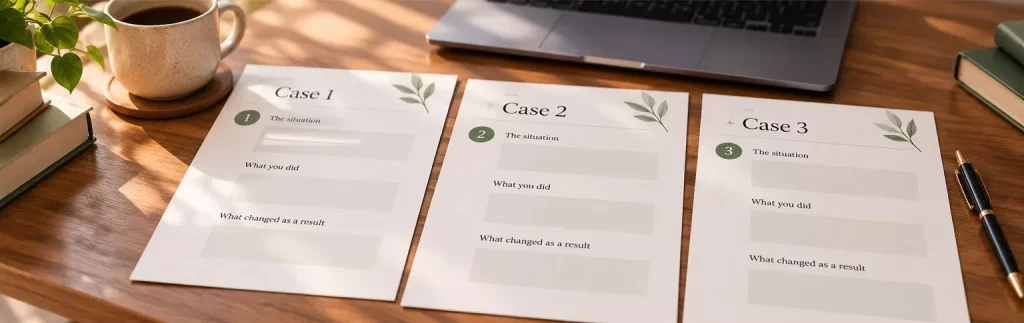
1. Your three client cases.
Pick three clients where the work went well.
The guidebook asks a few short questions about how you began with each.
No case notes, client names or identifying details needed.
You’re remembering, not writing a report.
A few lines per question is enough, in one sitting or one client at a time.
2. Your First Move, in your own words.
Put the three beginnings side by side.
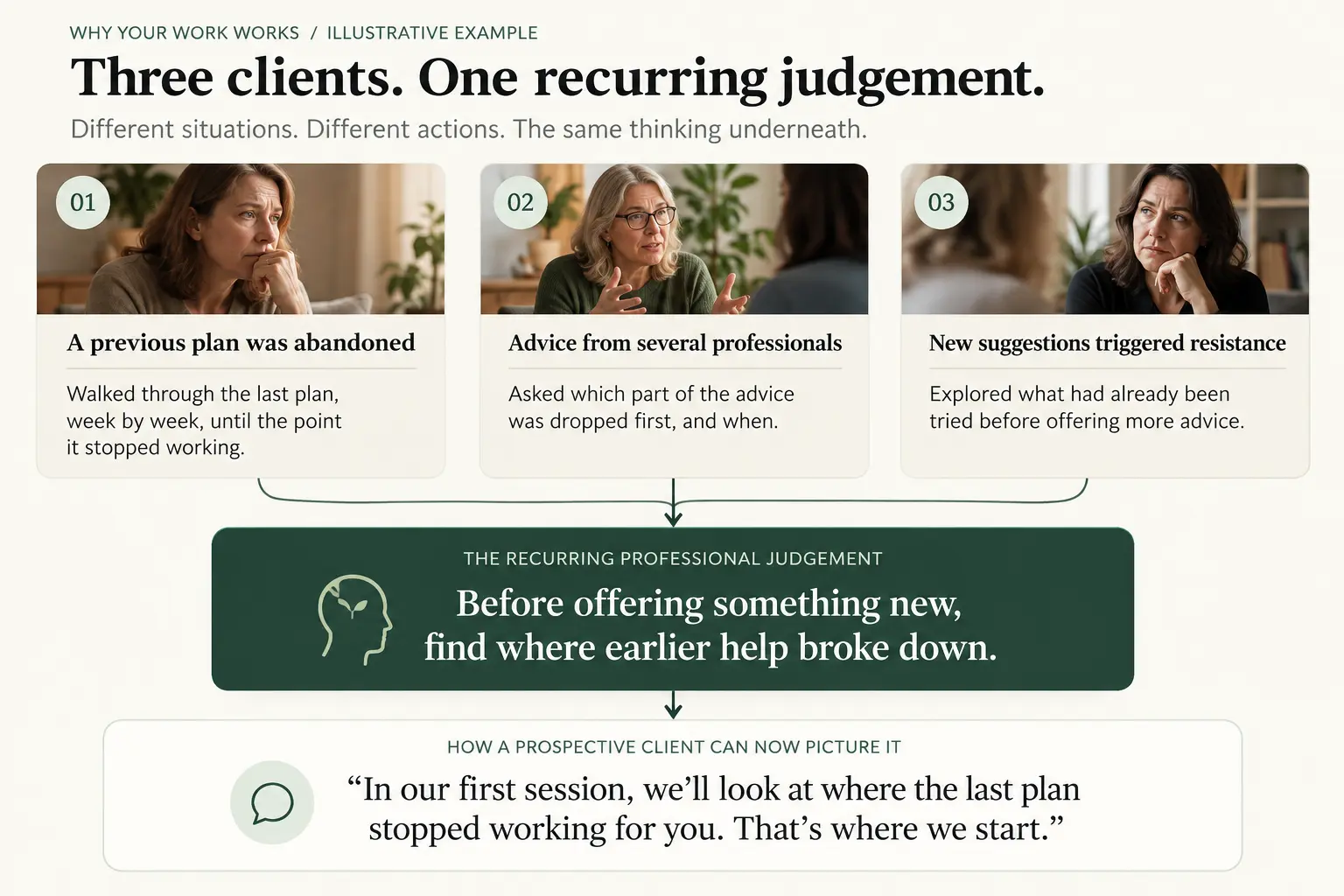
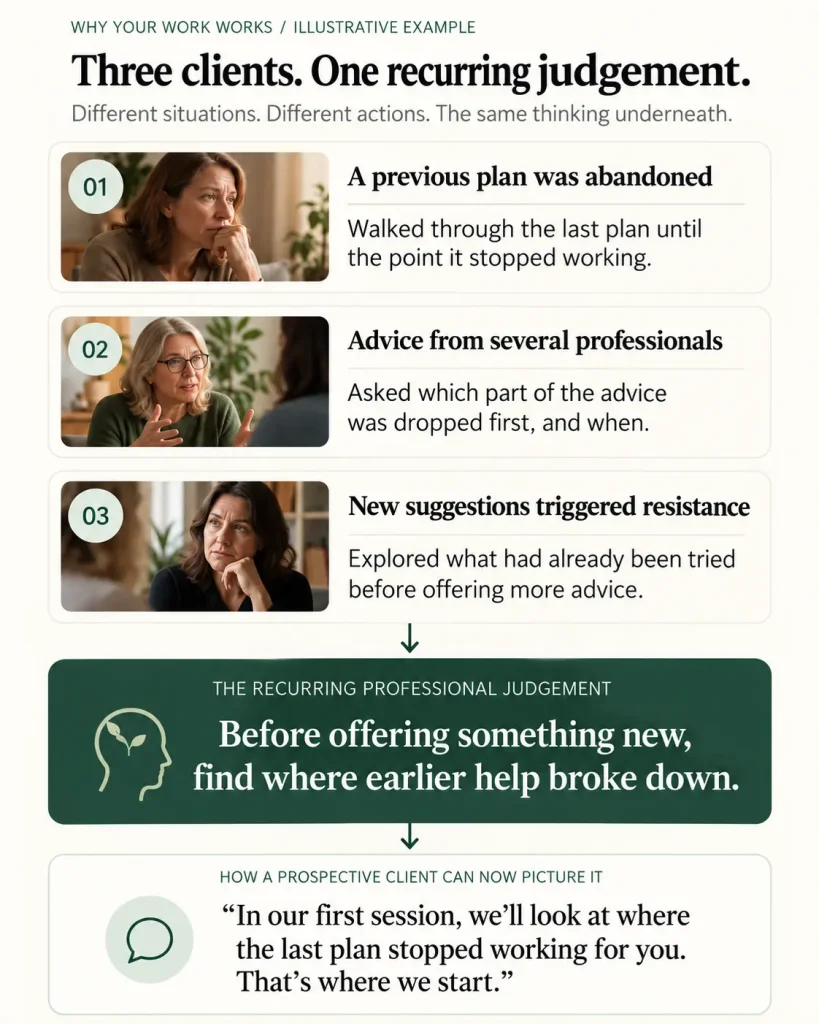
Look for a judgement that keeps showing up, even when the actions you took were different.
If a clear pattern emerges, that may be your First Move.
You write it down in a sentence, in your own words.
3. My personal reply, within 48 hours.
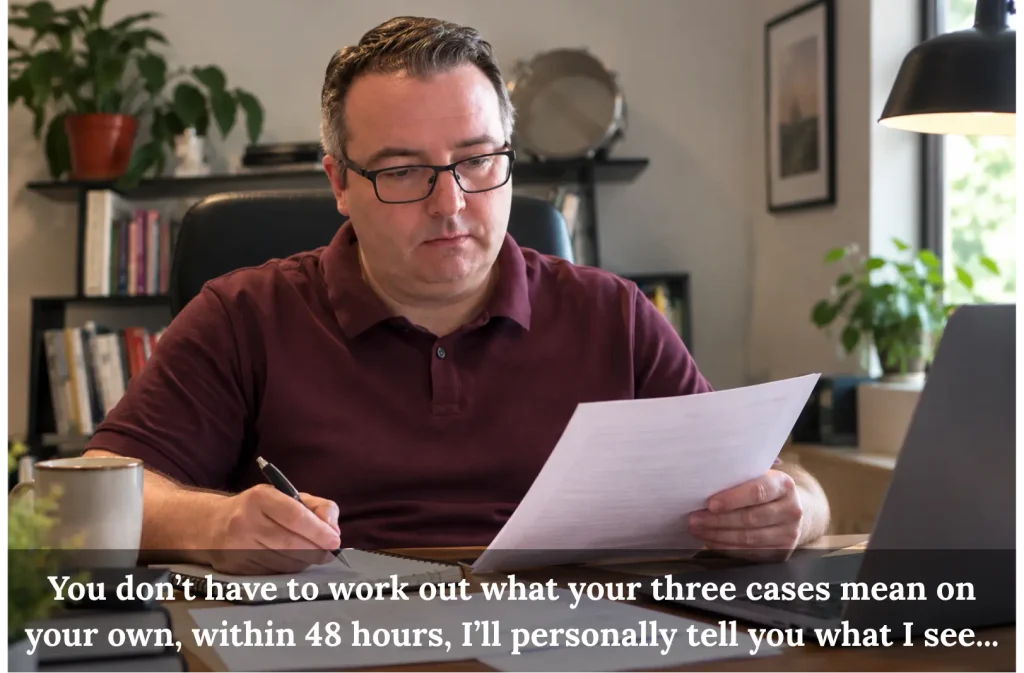
Send me your completed guidebook, and I’ll tell you what I can see.
Where there’s a clear First Move, I’ll then write it in words a client would recognise. understand, and picture starting with you.
So it’s ready for your website, social media profiles, directory listing or any other place you wish to use it.
You'll Have A Clearer Way To Show The Right People Why They Should Get In Touch With You
The next time you sit to write about your work, you’re not starting from another blank page.
You’re starting with evidence from your actual work and giving the right people a mcuh clearer reason to get in touch with you.
And when the next enquiry comes from someone who’s already read how you begin, pictured already working with you and writes, ‘That’s exactly what I need…’
…the conversation starts there, instead of with you explaining yourself.
And the people who already recommend you have one sentence they can pass on.
It’s $27 because we’re looking at one part of your practice: how you begin.
Before you spend more on a website, professional directory, social media or a copywriter, see what’s already there.
NOW AVAILABLE FOR INSTANT ACCESS

Why Your Work Works — $27 One-Time Payment

Want To See What My Personal Reply Could Look Like?
Here’s an illustrative example of what my reply could look like.
What you wrote about your three cases:
Client A: “She’d worked with two coaches before and couldn’t face another plan.
So I asked her to walk me through the last one, week by week, until she got to the point where she stopped.”
Client B: “He’d had advice from several professionals.
Instead of adding mine, I asked which part he’d dropped first, and when.”
Client C: “She got defensive whenever anyone made suggestions.
So we spent the first session going through what she’d tried.”
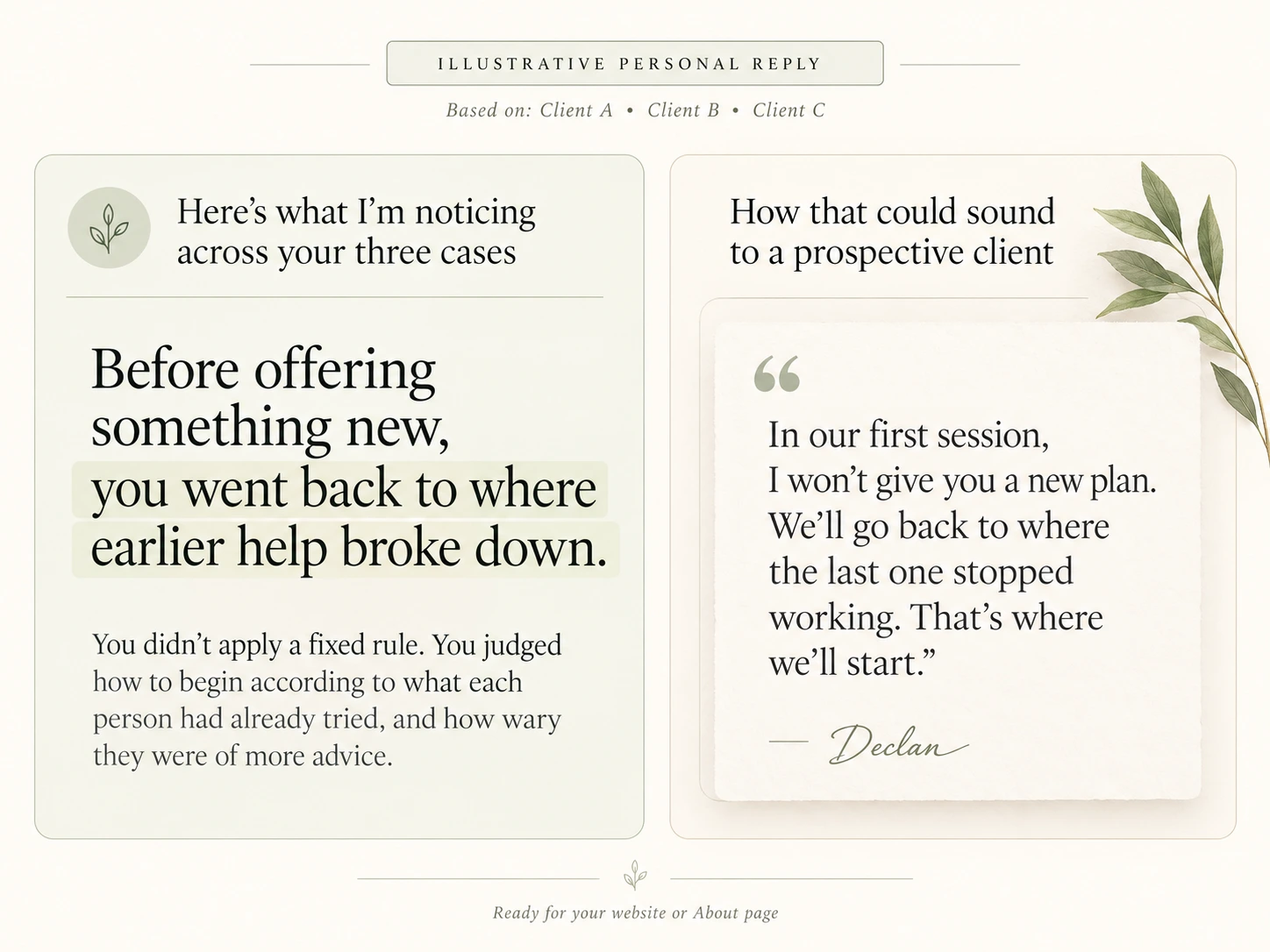
What I noticed across them:
Before offering anything new, you went back to the exact point where earlier help broke down.
And you didn’t apply it by rule.
You professionally judged it each time from how wary they were of more advice.
How that could sound to a prospective client:
“In our first session, I won’t give you a new plan. You’ll walk me through the last one you gave up on, and we’ll find the exact point it stopped working for you. That’s where we start.”
Someone who’s already abandoned three plans can picture that first session, and see that she won’t be handed a fourth.

$27 · Instant download · 30-day money-back guarantee support@thepremiumpractice.com
What It Sounds Like When Someone Finally Sees How Their Work Begins
These clips come from longer one-to-one sessions where I mapped each practitioner’s whole approach.
What you’ll hear is the first stage: how her work begins.
That’s the same part the guidebook helps you look for in your own client work.
Here’s Carla, a transformational coach and author of the book ‘Reignite Your Spark’:
Here’s Rosalind, a Spiritual Guide:
Carla doesn’t begin like Rosalind.
Rosalind doesn’t begin like Patricia.
Yours will be different again, which is why this starts with your client work, not a template.
If You Can't Describe How Your Work Begins More Clearly, I'll Refund The $27
Complete the guided process.
Compare your three beginnings.
If you still can’t describe how your work begins more clearly than you could before…
…simply email support@thepremiumpractice.com and you’ll get your $27 back.
Keep the guidebook. No form. No questions.
I’ve seen this often enough that I’m prepared to take that risk, not you.
Not sure what you’re seeing?
Send me your guidebook anyway and I’ll tell you what I can see.

$27 · Instant download · 30-day money-back guarantee support@thepremiumpractice.com
You Thought Of One Client Earlier, What Could Three Reveal About Your Work?
Earlier on this page, you thought of a recent client, and what you were checking for before you did anything else.
If something came to mind, you’re already holding a piece of the evidence.
Wait, and the next person a client sends you looks you up, finds the same missing words, and goes quiet.
Or think back to three clients now, while the first one is still in mind.
The evidence is in your client work.
Let’s go and find it.
In your corner,
Declan

$27 · Instant download · 30-day money-back guarantee support@thepremiumpractice.com
Frequently Asked Questions
Need help? support@thepremiumpractice.com
- "Do I need to believe I already have a methodology?"
No.
This only looks at how your work begins, and every practitioner begins somehow.
The guidebook just asks what actually happened.
- "What if how I begin just came from my training?"
Some of it probably did.
What you’re looking for is how years of using that training have shaped what you notice and check for when a new client arrives.
The question isn’t whether you invented every ingredient.
It’s what judgement shows up in how you begin.
- "I begin differently with every client. What if my three beginnings don't match?"
That’s normal. How you begin may adapt to each person.
The guidebook asks what was different about each situation, and tests whether there’s a condition behind the difference.
If there isn’t a clear one, it doesn’t force it, and that’s a valid result.
Send me your guidebook and I’ll tell you what I can see.
If you still can’t describe how your work begins more clearly than before, you’re covered by the guarantee.
- "What exactly do I get back from you?"
I read your completed guidebook personally.
Within 48 hours, I’ll tell you what I can see and, where your evidence supports a clear beginning, write it in words a client would recognise, ready for your website, social media profiles or directory listing.
- "How long does it really take?"
About an hour for most people.
The answers are short: a few lines on what you noticed and did at the start with each client.
You can do it in one sitting, or one client at a time.
If you’d rather be asked than fill in a page, there’s an interactive AI version at checkout that takes you through it one question at a time.
- "What if my work spans very different areas?"
If you suspect you begin in a similar way across very different areas, choose one strong case from each and use the exercise as the test.
Otherwise, choose three cases involving broadly the same kind of help.
- "What about client confidentiality?"
You use initials only and leave out anything that could identify a client.
You don’t need case notes; you describe only what you noticed and did.
You choose whether to send me your guidebook.
- "Is this the start of an expensive program?"
No.
Why Your Work Works is complete on its own, and what you find is yours to use however you like.
If you’d like help mapping what happens after the beginning, there’s a one-to-one session you’ll see after you purchase.
You never need it to use what you’ve found.

$27 · Instant download · 30-day money-back guarantee support@thepremiumpractice.com
Legal Disclosures
RESULTS DISCLAIMER:
Why Your Work Works helps you see and describe how your work begins. What you do with that description, and the results that follow, depend on you.
The FTC requires us to disclose that:
– Individual results will vary based on your practice area, years of experience, existing client base, how you use what you receive, and other factors.
– Why Your Work Works produces a description of how your work begins, based on your own client cases, and, where the evidence supports one, a personal reply putting it into words a client would recognise. We make no guarantee that either will produce more enquiries, booked calls, clients, higher fees or revenue.
– Business results that follow from these deliverables, including enquiries, client numbers, pricing and revenue, depend on how you use them and on market factors beyond our control.
– Any pricing changes or client results described on this page reflect those specific practitioners’ experiences and may not reflect yours.
– As with any professional investment, there is no guarantee of specific financial outcomes.
TESTIMONIALS, CLIPS AND CASE STORIES:
– The video clips on this page come from live one-to-one conversations in which we examined each practitioner’s client work. They are not results from buyers of Why Your Work Works unless stated.
– Stories labelled as composites combine details from real client sessions, with names and details changed to protect confidentiality.
– These experiences are not typical or guaranteed, and past results do not guarantee future results.
– Practitioners shown have given permission for their words to be shared.
YOUR CLIENT WORK AND CONFIDENTIALITY:
You choose what you share with us. We ask you to use client initials only and to leave out anything that could identify a client. Personal replies and session documents may be drafted with the help of AI tools and are reviewed personally before they are sent.
REFUNDS AND PAYMENT TERMS:
– Why Your Work Works: if you complete the guided process and still can’t describe how your work begins more clearly than you could before, email us within 30 days for a full refund.
SUPPORT:
For customer support, questions or refund requests, contact: support@thepremiumpractice.com
Average response time: 24–48 hours (usually much faster).
META DISCLAIMER:
This site is not part of the Facebook™ or Instagram™ websites or Meta Platforms, Inc. This site is not endorsed by Meta in any way. Facebook™ and Instagram™ are trademarks of Meta Platforms, Inc.
COPYRIGHT:
© 2026 The Premium Practice. All rights reserved.
No part of this material may be reproduced or transmitted in any form without written permission.